
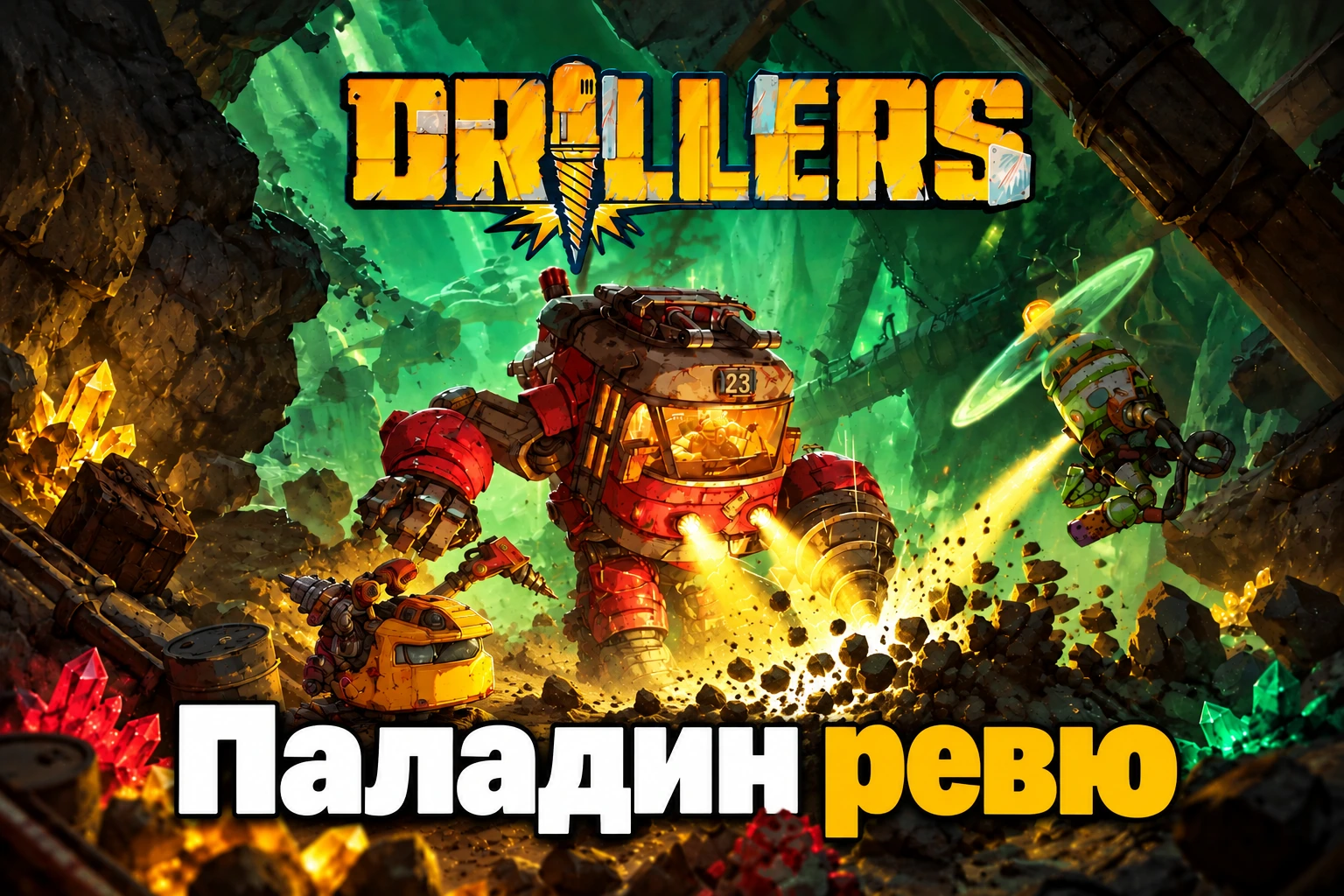
Drillers – review: Deep in the deckbuilding mines
Czech Games Edition has an excellent reputation for combining familiar mechanisms with original ideas and varied themes, regularly producing hits such as Dungeon Petz, Alchemists, Lost Ruins of Arnak, and SETI. Most of these titles have relatively accessible rules while still offering considerable strategic depth, and quite a few have found their way into my collection.
With its new 2026 release, Drillers, CGE continues that tradition. This time, the theme takes us deep beneath the surface of an abandoned mining complex in search of valuable minerals, technological upgrades, and, of course, victory.
The designers, Roman Bednář and Adam Španěl, are relatively new names in the hobby. Adam is the only one with previously published games, including the rather successful Project L, although that is a much lighter title. Drillers is a game for 1–4 players that combines familiar deck-building elements with resource management and an interesting approach to movement through the mine.
The question is: does Drillers offer enough new ideas beyond its attractive presentation and familiar deck-building mechanisms to rank among CGE’s best titles?
1. Theme
Players take on the roles of miners exploring an abandoned mining complex on an unnamed distant planet. Equipped with mechanical machines assembled from old and recycled parts, they descend ever deeper underground to extract valuable minerals and uncover forgotten technologies.
The theme is a welcome change from some of the increasingly overused themes in Eurogames. I have to admit that mining is one of my favourite settings, especially after spending many hours playing Deep Rock Galactic. Here, we operate mining machines that become progressively more capable, turning initially inefficient equipment into a powerful drilling and extraction system by improving our hand of cards.
The artwork is very appealing and successfully conveys an industrial atmosphere without leaning too heavily into steampunk.
The individual player boards are designed like control panels for the mining machines. The fuel indicator and the movement and drilling tracks make managing and upgrading your machine an engaging part of the experience. My only component-related complaint is that the colours of two minerals—yellow and green—can be confusing in poor lighting.
For a Eurogame, I would say that the mechanisms make thematic sense, and the rulebook itself is well structured. To reach the deeper levels of the mine, we need more powerful equipment (cards). The minerals we collect provide the means to purchase upgrades, while returning to the surface allows us to refuel, repair, and prepare our machine for the next expedition.

2. Rules
Each player starts with a basic deck of cards, as in a conventional deck-builder, thematically representing different parts of their drilling machine. Players also have a limited amount of fuel and storage space for minerals, both of which can be expanded considerably over subsequent turns.
As is typical of Eurogames, the objective is to score victory points by excavating tunnels, opening up deeper levels, and mining and selling minerals.
Each turn consists of three phases:
Operations
This is the main phase, during which players use cards, generate fuel, move between levels of the mine, excavate tunnels, and collect minerals.
Cards can generally be used in two ways: to activate their main action by paying a certain amount of fuel, or to generate additional fuel. Actions can be combined in virtually any order, allowing players to put together effective sequences.
Surfacing
If a player finishes the Operations phase on the surface, they can sell collected minerals, buy new cards, repair their machine, increase fuel and storage capacity, and refill the tank.
Returning to the surface is an important part of building a more efficient engine that makes subsequent trips into the mine even more exciting.
Upkeep
At the end of the turn, played cards go to the discard pile, the movement and drilling indicators are reset, and three new cards are drawn. Players can also retain cards for their next turn, although keeping more than one requires additional fuel.
The game ends when a player’s progress, measured by the accumulated mining tiles, reaches the end of the track on their board. The other players each get one final turn, after which the scores are calculated.
Points are earned from excavated corridors and barriers, collected minerals, completed objectives, and remaining credits. Points are deducted for cards with negative values left in the deck, and for having your machine underground rather than on the surface at the end of the game.
As mentioned, the rules follow a fairly intuitive logic, which makes the game easier to learn and play. The deck-building system provides considerable flexibility in decision-making, but the downside is that individual turns can become quite long.
3. Mechanics
At its core, Drillers is a deck-building game, but several interesting design decisions distinguish it from more traditional examples of the genre.
Dual-purpose cards
Perhaps the most important mechanism is that every card can be used in two ways. Players can activate its main action or turn it into fuel, forcing them to consider not only what they want to do, but also how they will pay for it. This creates a series of small but meaningful decisions. A card with a high drilling value, for example, might help us reach a deeper level, but using it for fuel could allow us to activate several other cards in a sequence that achieves a more desirable result.
More predictable deck-building
Unlike most traditional deck-builders, newly purchased cards are placed on top of the draw deck, rather than in the discard pile, on a makeshift card stand.
The top card of the deck is also visible to its owner, providing valuable information about which card will be drawn next when the relevant effect is activated.
These seemingly small changes give players greater control over how their personal deck develops and reduce some of the randomness normally associated with the genre.
Another important feature is the ability to remove unwanted cards through repairs, either while on the surface or through card effects. Since many starting cards carry negative victory points, thinning the deck not only improves its efficiency but also directly affects the final score.

Exploration and development of the mine
The mine is a shared space that gradually changes throughout the game.
Excavating tunnels adds new minerals to the available resources, while removing barriers opens access to deeper levels with more valuable deposits and additional effect cards.
Interestingly, opening new areas does not benefit only the player who did the digging: everyone else can immediately take advantage of the new opportunities as well.
This creates indirect interaction between players, with each person’s actions contributing to the development of the shared board.
Drones and permanent upgrades
Drones allow players to sell minerals or buy cards without returning to the surface, adding another layer of flexibility during the active phase.
4. Strategy
Strategy in Drillers revolves around balancing short-term efficiency against long-term development.
Fuel management is at the heart of almost every decision.
Because fuel powers the cards that generate movement, drilling, and other actions, spending it too quickly can leave players underground at the end of their turn or force an inefficient return to the surface.
The decision of when to return is particularly interesting.
Returning early lets us sell minerals, refuel, remove weak cards, and invest in upgrades. Staying underground, on the other hand, allows us to continue mining and potentially beat our opponents to valuable tiles.
Neither approach is universally correct. The choice depends heavily on the current state of the mine, the available cards, and the positions of the other players.
Building a good deck adds another strategic dimension.
Players can focus on moving between mine levels, drilling efficiency, fuel generation, or abilities that allow them to stay underground longer. Removing inefficient starting cards can be just as important as buying new ones.
There is also a big difference between investing in future turns and chasing quick victory points. Buying cards improves our engine, but the game is won through mining and scoring points, not simply by building the most impressive deck.
Drillers is definitely an exciting race as well. If we spend too long upgrading our machine, we may not have enough time to make use of it before someone else triggers the end of the game by quickly accumulating mining tiles and accelerating their progress.
Although the main strategic approaches are relatively easy to understand, optimising them certainly requires more careful planning.
The main drawback is that this freedom can lead to excessively long turns, and players prone to overthinking can slow the game down significantly. A player’s entire turn consists of a long series of micro-decisions—often more than 20, perhaps—which definitely makes the game better suited to two or, at most, three players.
5. Game Arc
One of the most satisfying aspects of Drillers is the sense of progression throughout the game.
The opening turns are quite modest. Players have inefficient cards, limited fuel, and little storage capacity. The first expeditions are usually short, and returning to the surface is necessary to begin improving the machine.
In the middle of the game, the possibilities gradually expand. New cards offer stronger actions and effects, players improve their fuel and mineral storage capacities, and additional levels of the mine become accessible.
More valuable minerals begin to be collected, and players take longer and increasingly complex turns.
This development creates a strong sense of progress. Actions that initially required considerable effort gradually become easier, and players can pursue more ambitious goals.
The final part of the game introduces a new kind of tension, as everyone races to be the first to end the game and claim the 18-point token. There is also the dilemma of whether to embark on one more expedition or return to the surface to avoid the penalty for finishing underground.
Overall, the game arc is very satisfying. The game does not overstay its welcome; it ends just when it should.
6. Replayability
Drillers offers several sources of variety that help individual plays feel different from one another.
Different mine-level cards introduce changing conditions and effects, while the order in which cards appear in the market influences how each player’s deck develops. These elements encourage experimenting with different strategies and card combinations.
The solo mode adds another dimension, offering four difficulty levels against an automated opponent.
Nevertheless, there are some limitations worth mentioning, and I think the game would benefit greatly from expansions in the future.
All players start with completely identical decks and capabilities.
Also, although the market contains a variety of cards, after a few plays their repetition starts to become noticeable. The same applies to some of the effects on the different mine levels.
This does not necessarily mean that replayability is low, but it suggests that the game’s long-term place in a collection depends more on the pleasure of optimising its core mechanisms than on discovering radically different ways to play.
The design seems particularly well suited to future expansions that could add new cards, level effects, or asymmetric starting abilities and resources.
7. Player Count
Drillers supports one to four players, but the experience definitely changes depending on the number of participants.
Solo
The solo mode uses an automated corporate opponent with four difficulty levels. Although I haven’t tried it myself, I think the game is very well suited to solo play, given the length of individual turns and the relatively low interaction typical of Eurogames.
Two players
In my opinion, this is the ideal player count for Drillers. As I mentioned earlier, turns are long and consist of an extended sequence of micro-decisions. Adding more players mainly increases the playtime without necessarily adding to the enjoyment or tension.
Three and four players
With more players, the mine develops faster, competition for cards and tiles becomes more noticeable, and the timing of the game’s end is harder to predict. The main downside, however, is the long wait between turns.
Ultimately, the preferred player count depends largely on how quickly your group makes decisions and whether everyone enjoys watching the other players’ combinations unfold.
8. Summary and Verdict
Drillers combines familiar deck-building mechanisms with an original theme and several particularly interesting design choices.
Perhaps its greatest strength is the control it gives players over their decisions, and at times the game can feel a little like a sandbox. Dual-purpose cards, the visible top card of the deck, the relatively easy removal of unwanted cards, and the freedom to plan actions create a system that feels familiar yet engaging.
The component quality also deserves praise. The illustrations, machine miniatures, and especially the individual player boards are very well executed and reflect CGE’s usual production standards.
Nevertheless, Drillers is not without weaknesses.
The lack of asymmetric starting abilities limits the differences between players, and the variety of some cards and effects may start to feel insufficient after three or four plays.
The freedom to combine actions can lead to lengthy turns, particularly with players prone to overanalysis. Combined with the relatively low level of interaction, this may make the game less appealing to groups that prefer more player interaction and larger tables.
Despite these reservations, Drillers is a very good, modern combination of accessible rules and strategic decisions, and I would certainly expect it to be among the hits of 2026, especially for deck-building fans. I’m curious to see future expansions with more cards, new miniatures, and characters that introduce a little more asymmetry to each game.
If Drillers has caught your interest, you can explore the game at Paladin Games, where you’ll find more information, its current price, and availability.